In a recent post Abby mentioned the importance of teaching hygiene skills early on. The goal is for our kids/adolescents to be as independent as possible in activities of daily living so that parents can gradually back off from prompting through all the steps to complete a certain task. In previous posts we've tackled topics such as toileting and brushing teeth, so today I'm going to give some ideas about showering/bathing!
Many people, especially those on the autism spectrum can become completely distracted and off task during showering/bathing times. The steps of how to "get clean" are often not intuitive to them and so we have to specifically teach these skills. Time and time again parents share with us how their adolescent child will get in the shower and be in there for 30-45 minutes and come out looking just as dirty as before getting in! At this age parents do not feel that they should have to give constant reminders and prompts of what to do, plus we often hear that they tell their child time and time again to remember to wash their hair or use soap etc. but some how it's not all sinking in! So, let's try another strategy-- let's make it visual! The beauty of writing things down or showing in another visual way (whether it be with pictures or with objects) is that we can back ourselves out of that process and the steps are still outlined for them to be independent.
 Ideas for Young Children: At an early age
 we can get our kids involved in the process of bathing. Bath time can either be a dreaded or a favored activity, but first we need to make it clear to the child where it is that he/she is going by using an object to get them there. So, think about a toy that your child loves to play with in the bath and hand him/her this toy every time it's bath time. Your child will then take the toy, for example a rubber ducky to the tub and eventually begin to associate this object with that activity.
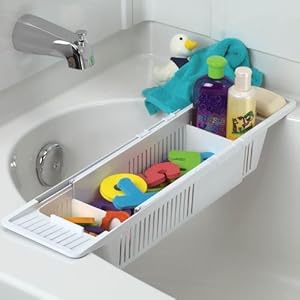
Next, have all the items you are going to use to "get clean" in a container. I love the product below that can be found at amazon.com:
This way you can arrange the items in the order (from left to right) of which ones you're going to use first, second, and so on. After you have used the soap, for example which may be the first item, then your child can put it in another container, maybe a bucket to signify that you are "finished" with the soap and you can then move onto the next step. Eventually, as your child becomes more familiar with this process, then he/she will be more independent in performing these steps independently.
Ideas for Older Children/Adolescents: As kids get older, they are going to move into taking showers, but even older kids need to be reminded of exactly the steps required to get clean. For individuals who are reading, show them when they are required to bathe by writing it on their daily checklist. After all, this may not be a top priority to many and your child may feel that he/she only needs to shower once a week, so let's make this clear again by writing it down! Then, once in the shower, we need to have written lists of what to do to avoid having to constantly call out, "did you wash your hair?", "did you wash your face?" etc! One strategy we've used is to make a laminated flip book detailing each step that the person can flip through to make sure not to leave anything out.
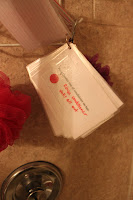

Note the additional visuals-- we have showed this person how much shampoo to use by giving a example (the red dot). We've also used some pictures to help explain concepts such as rinsing your hair by putting your entire head under the water.
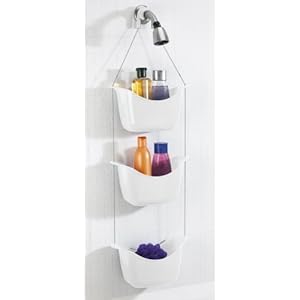
* Some individuals may not be particularly motivated to use these systems, especially if there is a lot of written information, however. Therefore, we can always use more of our basic systems even if the individual is reading. We all use our own systems in the shower, and I know for me personally that I often wash my hair twice because I've zoned out and forgotten whether or not I had already done it! So, another idea is to use a basic shower caddy and organize our shower materials in specific ways.
Make it Simple: Here arrange the shampoo, conditioner, soap etc in this shower caddy moving from top-to-bottom and again the individual can put the product already used either on the edge of the bathtub or a basket on the floor of the shower. That way the person remembers what they have already done.
If you notice that your child does not seem to know how much shampoo or condition to use, etc., then another thing you can do is to:
Write instructions on the bottle (in permanent marker). For example, "use 1 squirt of shampoo."
Measure out ahead of time: If you still notice that your child has used way too much or too little shampoo, then you may just want to pre-measure and put the products in small containers to make things easier.
* Remember the goal is for you to back yourself out of this process so that you don't have to record verbal instructions of what to do for your child to take with him/her to college! And don't take anything for granted-- you may need to teach things you've never even dreamed of having to teach. Just because you say "put your deodorant on," you may have to specify where it goes. I've heard one story of a teenager going off to college who saw a commercial for deodorant where they showed how clear it came out by using someone's arm and that's where he put his deodorant for several years!
Try out several things and find out what system is easiest and stick with that. The first thing you try may not work, but keep trying and I promise you will find something that makes sense for your child and you can rest assured that you won't have to be the constant reminder until the end of time! Anyone else try a strategy not mentioned that works for you? We'd love to hear from you.
-Molly